
About This Worksheet
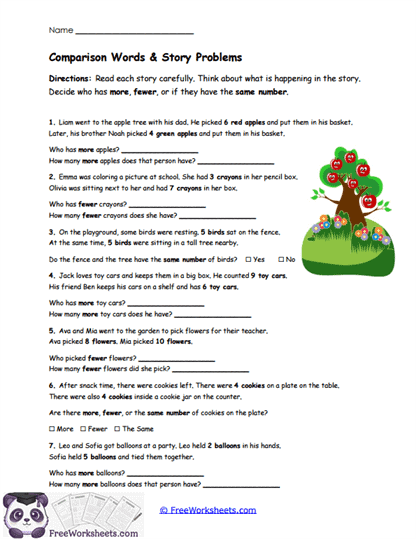
This worksheet is a story-based comparison activity designed to strengthen subtraction within 10 through contextual word problems. Students read short scenarios and determine how many more, fewer, or the same items are present. Intended for first grade learners, it integrates reading comprehension with mathematical reasoning. The activity emphasizes understanding comparison vocabulary before performing subtraction. For example, 7 balloons and 5 balloons becomes 7 − 5 = 2. By interpreting written scenarios carefully, students deepen their understanding of subtraction as finding the difference between quantities.
Curriculum and Grade Alignment
This worksheet aligns with first grade operations and algebraic thinking standards focused on solving word problems. The primary objective is for students to interpret comparison language and represent it using subtraction equations within 10. Students should have prior experience solving basic subtraction facts and reading simple math stories. The content supports Common Core Standard 1.OA.A.1, which emphasizes solving addition and subtraction word problems within 20, with a focus here on within 10. It also aligns with TEKS 1.3(B), addressing comparison of quantities and number relationships. This resource builds fluency in translating written language into mathematical expressions.
Student Tasks
On this worksheet, students will read short math stories that describe two quantities being compared. They identify whether one group has more, fewer, or the same number of items. Students calculate the difference between the quantities using subtraction within 10. Some questions may require determining if the amounts are equal without subtracting. Answers are recorded clearly in the provided spaces. The tasks emphasize reading comprehension alongside computational accuracy.
Common Challenges and Misconceptions
Students may struggle to interpret comparison vocabulary accurately within the story context. Some learners may overlook key numbers embedded in sentences. Others might assume that every problem requires subtraction, even when quantities are equal. Confusion between “more” and “fewer” can also lead to incorrect equation setup. Rushing through the reading may result in missed details that change the answer. Teachers can encourage students to underline important numbers and restate the question before solving.
Implementation Guidance
Teachers can use this worksheet during math lessons that integrate literacy and numeracy skills. It works well as guided practice when introducing comparison word problems. Small-group discussion allows students to explain their reasoning and clarify misunderstandings. Parents and homeschool educators may use this worksheet to strengthen both reading comprehension and subtraction fluency. Reviewing one sample story problem together before independent work supports confidence. This activity also functions as a formative assessment of word problem mastery.
Details and Features
The worksheet includes clearly written short stories that are developmentally appropriate for early readers. Each problem provides adequate space for students to write their answers. The layout promotes focused reading without unnecessary distractions. Questions vary slightly in structure to encourage flexible thinking. The printable black-and-white format ensures easy distribution. Its consistent design supports classroom implementation and repeated practice.