
About This Worksheet
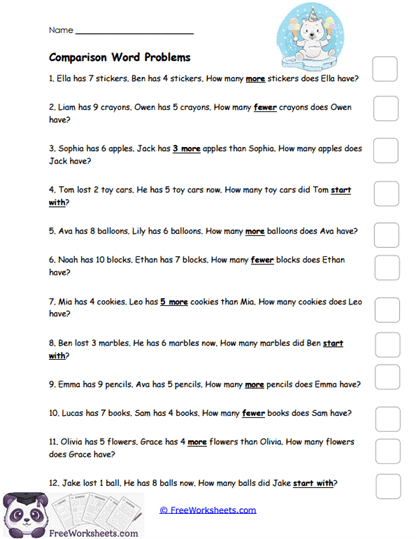
This worksheet is a foundational math resource designed to help students solve comparison word problems within 10 using subtraction strategies. It focuses on identifying how many more or fewer items one group has compared to another, reinforcing early number sense and operations. Intended primarily for kindergarten and first grade students, it strengthens both computational fluency and mathematical language development. Learners engage with simple real-world scenarios that require interpreting quantities before solving. For example, 6 bugs compared to 4 bugs becomes 6 − 4 = 2. This structured approach builds conceptual understanding of subtraction as finding the difference rather than just taking away.
Curriculum and Grade Alignment
This worksheet aligns with early elementary standards focused on addition and subtraction within 10. The primary learning objective is for students to solve comparison word problems and determine unknown differences accurately. Students should already demonstrate one-to-one correspondence and reliable counting skills before beginning this activity. The content directly supports Common Core Standard K.OA.A.1 and 1.OA.A.1, which emphasize representing and solving word problems involving addition and subtraction within 10. It also aligns with TEKS K.3(H) and 1.3(B), which require students to compare sets and determine how many more or fewer. This resource serves as a bridge between concrete counting experiences and abstract equation writing.
Student Tasks
On this worksheet, students will read short comparison-based word problems featuring familiar objects such as bugs, balloons, ducks, and apples. They must identify which quantity is greater and determine the difference using subtraction within 10. Learners translate the story context into a mathematical equation that models the comparison accurately. Students record both the subtraction sentence and the final numerical answer in the space provided. Each problem encourages careful reading to distinguish between “more” and “fewer.” The tasks promote mathematical reasoning by requiring students to interpret context before computing.
Common Challenges and Misconceptions
Students often confuse the meaning of “how many more” with simple addition rather than subtraction. Some learners reverse the subtraction order, subtracting the larger number from the smaller incorrectly. Others may struggle to connect the written word problem to the visual picture representation. Young mathematicians sometimes focus on isolated numbers without understanding the comparison relationship. Additionally, miscounting visual models can lead to avoidable computational errors. Teachers can address these misconceptions by modeling comparison language explicitly and using think-aloud strategies to demonstrate how to set up the subtraction equation correctly.
Implementation Guidance
Teachers can introduce this worksheet after hands-on comparison activities using manipulatives such as counters or linking cubes. It works effectively during guided math instruction, math centers, or as a formative assessment tool to check subtraction understanding. Small-group instruction allows educators to reinforce comparison vocabulary and correct misconceptions in real time. Parents and homeschool educators can use this worksheet for structured subtraction practice aligned with classroom standards. Reviewing one example together before independent work supports confidence and accuracy. This activity also pairs well with anchor charts highlighting “more,” “fewer,” and “the same.”
Details and Features
The worksheet includes clearly illustrated picture models that support visual learners and early readers. Each problem provides designated space for writing both the number sentence and the final answer. The layout is intentionally uncluttered to reduce cognitive overload and promote focus. Problems are organized sequentially to gradually reinforce comparison reasoning. The printable format is black-and-white for easy classroom copying. Its straightforward design makes it suitable for both independent practice and teacher-led instruction.