
About This Worksheet
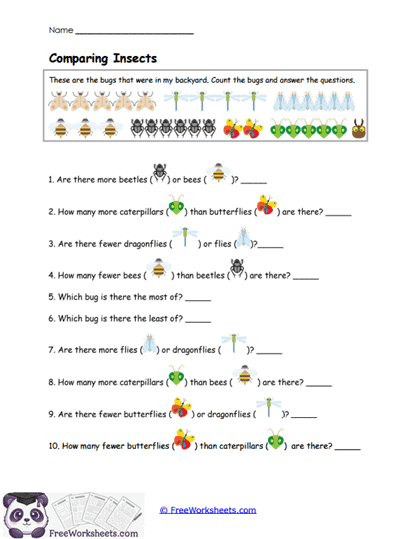
This worksheet is a counting and comparison activity centered on groups of insects. Students count each insect category and determine how many more or fewer insects appear in one group compared to another. Designed for kindergarten and first grade learners, it strengthens subtraction within 10 while reinforcing one-to-one correspondence. The engaging science theme supports cross-curricular learning connections. For example, 8 bees and 5 beetles becomes 8 − 5 = 3. By pairing visual models with subtraction equations, students develop a deeper conceptual understanding of finding the difference.
Curriculum and Grade Alignment
This resource aligns with early elementary operations and algebraic thinking standards focused on subtraction within 10. The primary learning goal is for students to compare two groups and compute the difference accurately. Students should already be able to count objects consistently and recognize numerals to 10 before completing this worksheet. The content supports Common Core Standards K.OA.A.1 and 1.OA.A.1, which emphasize solving subtraction word problems. It also aligns with TEKS K.3(H) and 1.3(B), addressing comparison of sets and number relationships. This worksheet strengthens the connection between visual representation and symbolic subtraction.
Student Tasks
On this worksheet, students will count groups of illustrated insects such as bees, butterflies, ants, or beetles. After determining the totals, they compare the quantities to identify which group has more insects. Students subtract to calculate how many more insects are in the larger group. Some questions may require identifying the group with the least number of insects. Answers are recorded clearly in the provided spaces. The tasks encourage careful counting before performing subtraction.
Common Challenges and Misconceptions
Students may miscount when insects are positioned closely together or appear visually similar. Some learners may rush to subtract without verifying their totals first. Others might struggle with determining which number should come first in the subtraction equation. Confusion between “most,” “least,” and “how many more” can also lead to errors. Inconsistent counting strategies may result in skipped or double-counted insects. Teachers can address these challenges by encouraging students to point to each image while counting and to restate the question before solving.
Implementation Guidance
Teachers can use this worksheet during math lessons that integrate science themes, reinforcing interdisciplinary learning. It works well as small-group practice when reviewing subtraction within 10. Guided discussion allows students to explain their comparison reasoning aloud. Parents and homeschool educators may pair this worksheet with outdoor insect observations or science units. Using physical counters alongside the pictures can reinforce conceptual understanding. This resource also serves as a formative assessment of early subtraction and comparison skills.
Details and Features
The worksheet includes clear and engaging insect illustrations that support visual learners. Each problem provides sufficient space for students to record their answers neatly. The layout is structured to minimize distractions and promote focus. Visual groupings are clearly separated to assist accurate counting. The black-and-white printable format makes it practical for classroom copying. Its science-themed design increases student engagement while maintaining instructional rigor.