
About This Worksheet
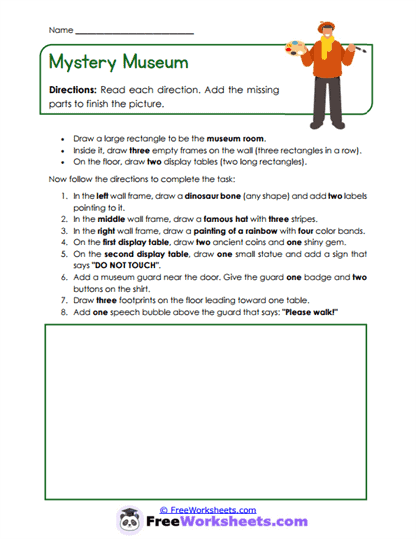
This worksheet is a multi-step drawing and comprehension activity that combines creative thinking with detailed direction following. Students read a set of instructions to construct a museum scene with specific labeled elements. Designed for grades 2-4, it strengthens reading comprehension, spatial reasoning, and attention to detail. The activity requires students to interpret descriptive language carefully before drawing. For example, adding a dinosaur bone and labeling display cases requires precision and sequencing. This structured creative task reinforces the importance of completing each step accurately.
Curriculum and Grade Alignment
This worksheet aligns with upper elementary reading standards focused on following multi-step written instructions. The primary learning objective is improving students’ ability to interpret complex directions and execute them correctly. Students should demonstrate solid reading fluency and basic drawing skills before beginning. The content supports Common Core Reading Standards RF.2.4 and RI.3.3, which emphasize understanding steps in informational texts. It also reinforces executive functioning skills such as planning and sustained attention. This resource builds independence in task completion.
Student Tasks
On this worksheet, students will first draw the basic museum structure as described. They then follow eight additional directions to add labeled objects, characters, and details. Each step requires attention to placement, labeling, and descriptive features. Students must include specific items such as display tables, artwork, signs, and speech bubbles. Careful sequencing ensures the final drawing reflects all instructions accurately. The task integrates reading comprehension with creative execution.
Common Challenges and Misconceptions
Students may begin drawing before reading all directions fully. Some learners might miss labeling requirements or overlook specific descriptive details. Others may misinterpret spatial placement instructions. Confusion can arise when directions contain multiple actions in one sentence. Rushing may result in incomplete drawings. Teachers can encourage students to check off each instruction as it is completed to ensure accuracy.
Implementation Guidance
Teachers can use this worksheet as an engaging comprehension assessment during literacy centers. It works well as a whole-class listening activity when directions are read aloud. Small-group use allows educators to clarify vocabulary and spatial terms. Parents and homeschool educators may use it to strengthen reading stamina and careful task completion. Modeling how to break down longer instructions improves student success. This activity also supports cross-curricular integration with art and social studies themes.
Details and Features
The worksheet includes a large blank drawing space for student artwork. Directions are clearly numbered and structured in logical order. Instructions incorporate labeling, spatial awareness, and descriptive details. The layout is clean and organized for easy tracking. The black-and-white printable format supports classroom efficiency. Its creative theme increases engagement while reinforcing academic skills.