
About This Worksheet
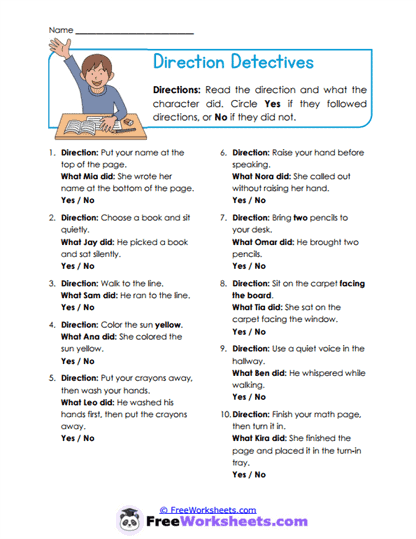
This worksheet is a reading comprehension and behavior analysis activity focused on determining whether directions were followed correctly. Students read a stated direction and then analyze what a character actually did. Designed for grades 1-3, it strengthens attention to detail, listening skills, and comprehension accuracy. The activity requires students to compare instructions with actions carefully. For example, if the direction says to walk to the line and a character runs, students must recognize that the instruction was not followed. This detective-style format builds critical thinking and careful reading habits.
Curriculum and Grade Alignment
This worksheet aligns with early elementary reading standards focused on understanding and evaluating text. The primary learning objective is helping students determine whether actions match given instructions. Students should demonstrate basic reading fluency and comprehension before completing this activity. The content supports Common Core Reading Standards RL.1.1 and RL.2.1, which emphasize asking and answering questions about key details. It also reinforces executive functioning skills such as sustained attention and comparison. This resource promotes analytical thinking across subject areas.
Student Tasks
On this worksheet, students will read a stated direction for a classroom task. They then read a short description of what a character did in response. Students decide whether the character followed the direction by circling Yes or No. Each item requires careful comparison between the instruction and the action. Learners must identify small differences that change whether the direction was followed. The task promotes careful reading and evaluation skills.
Common Challenges and Misconceptions
Students may skim the action description and overlook key differences. Some learners might assume that partially following directions counts as fully correct. Others may focus on only one word rather than analyzing the entire sentence. Confusion can arise when directions include multiple steps. Additionally, rushing through the worksheet may result in avoidable mistakes. Teachers can encourage students to underline the key verb in both the direction and the action before deciding.
Implementation Guidance
Teachers can use this worksheet as a formative assessment of listening and reading comprehension skills. It works effectively during small-group instruction focused on careful comparison. Class discussion after each question encourages students to explain their reasoning. Parents and homeschool educators may use this worksheet to reinforce the importance of following directions accurately. Modeling one example before independent work increases clarity. This activity also strengthens self-monitoring skills.
Details and Features
The worksheet presents clearly written directions paired with short action descriptions. Each question includes a simple Yes or No response option. The layout supports focused reading and organized decision-making. The black-and-white printable format allows for easy classroom copying. Statements are developmentally appropriate for primary learners. Its structured design supports repeated practice in direction analysis.