
About This Worksheet
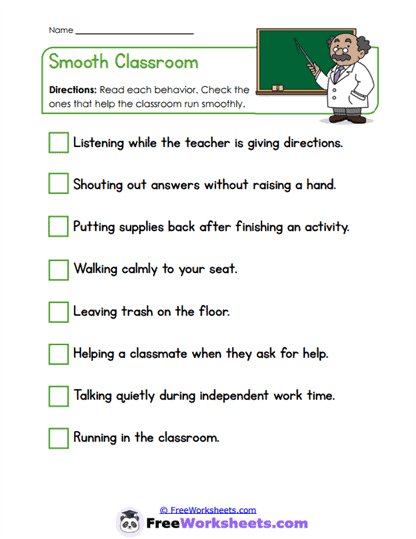
This worksheet is a behavior identification activity focused on recognizing actions that help a classroom run smoothly. Students evaluate a list of behaviors and select the ones that contribute to a positive, organized learning environment. Designed for kindergarten through second grade learners, it reinforces social-emotional learning and classroom management expectations. The activity emphasizes distinguishing between helpful and disruptive behaviors. For example, “Walking calmly to your seat” supports a smooth classroom, while “Running in the classroom” does not. This format strengthens students’ understanding of how individual actions impact the overall learning environment.
Curriculum and Grade Alignment
This worksheet aligns with early elementary SEL standards related to self-management and responsible decision-making. The primary objective is to help students identify behaviors that promote safety, respect, and productivity. Students should already be familiar with basic classroom rules before completing this activity. The content supports Common Core Speaking and Listening Standards SL.K.1 and SL.1.1 by reinforcing participation and collaboration norms. It also aligns with CASEL competencies in self-awareness and relationship skills. This resource builds awareness of how behavior choices affect classroom functioning.
Student Tasks
On this worksheet, students will read a list of classroom behaviors presented in checklist form. They determine which actions help the classroom run smoothly. Students check or mark the boxes next to behaviors that reflect positive choices. Careful reading is required to distinguish supportive behaviors from disruptive ones. Learners must evaluate actions such as listening, shouting out, helping classmates, and leaving trash. The task promotes thoughtful analysis of classroom expectations.
Common Challenges and Misconceptions
Students may select behaviors based on personal preference rather than classroom expectations. Some learners might misinterpret subtle behaviors that require deeper understanding. Others may check all positive-sounding statements without evaluating the full action. Confusion may arise when behaviors appear neutral but are context-dependent. Younger students may rush through the checklist without careful reading. Teachers can model reviewing each statement aloud and discussing why it helps or disrupts the classroom.
Implementation Guidance
Teachers can use this worksheet during the first weeks of school to reinforce established routines. It works well as part of a classroom meeting focused on building community expectations. Small-group discussion allows students to explain their selections and reasoning. Parents and homeschool educators may use this activity to discuss expectations for focused learning time at home. Reviewing classroom norms before completing the checklist improves comprehension. This worksheet also serves as a quick formative assessment of behavior understanding.
Details and Features
The worksheet includes a clearly organized checklist format for easy completion. Behavior statements are written in developmentally appropriate language for primary students. The layout is uncluttered to support focused reading. Checkboxes make responses simple and visually clear. The black-and-white printable format ensures classroom-friendly copying. Its straightforward structure supports both discussion and independent reflection.