
About This Worksheet
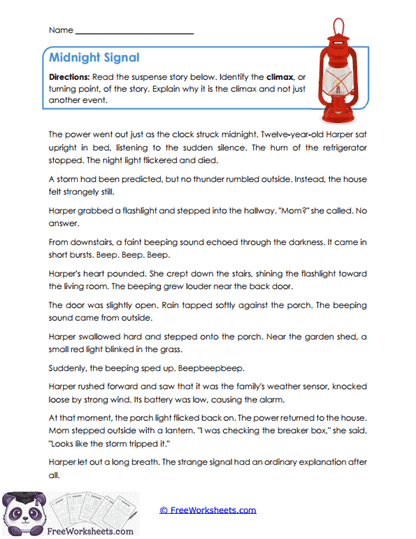
This worksheet is a story elements activity that focuses on identifying the climax, or turning point, in a suspense story. It is designed for Grade 5 students who are learning how tension builds and peaks in a narrative. Students explore how one key moment stands out as the most intense or important. For example, a strange sound becomes the moment where everything changes in the story.
Curriculum and Grade Alignment
This worksheet supports Grade 5 students in understanding plot structure, especially the climax. It helps them recognize how stories build toward a turning point. It aligns with Common Core RL.5.3, which focuses on analyzing events and their impact. It also connects to TEKS 5.8A through identifying key plot elements.
Student Tasks
On this worksheet, students will read a suspenseful story about a mysterious signal in the middle of the night. They identify the climax and explain why it is the turning point. Students compare that moment to other events in the story to show why it stands out. They support their thinking with details from the text.
Common Challenges and Misconceptions
Students may pick an exciting moment that is not actually the climax. Some might confuse rising action with the turning point. Others may give answers without clearly explaining their reasoning. It helps to guide students to look for the moment where the main problem reaches its peak or begins to resolve.
Implementation Guidance
Teachers can use this worksheet when introducing or reviewing the concept of climax. It works well as a follow-up to reading suspense or mystery stories together. Parents can use it to help children talk through what makes a moment important in a story. It also makes a great small group discussion activity.
Details and Features
The worksheet includes an engaging suspense passage that keeps students interested. It offers clear directions and space for thoughtful written responses. The design is clean and easy to print for classroom or home use. It supports both comprehension and deeper analysis of story structure.