
About This Worksheet
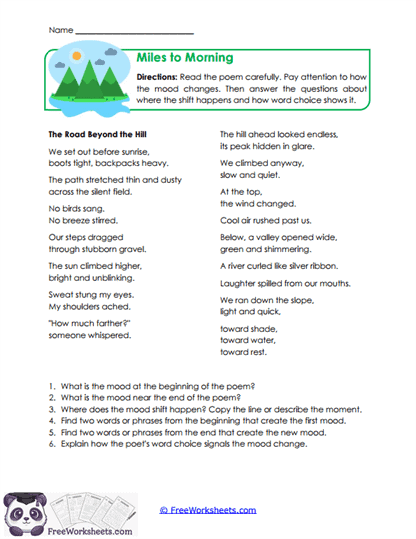
This worksheet is a mood and tone analysis activity focused on tracking how emotions change in poetry. It helps Grade 5 students identify mood at different points and explain how word choice signals those shifts. The subject area is English Language Arts. Students learn how poets guide readers through emotional journeys using carefully chosen language.
Curriculum and Grade Alignment
This activity supports Grade 5 students in analyzing mood and tone in poetry. The primary goal is identifying emotional shifts and explaining how they are created. Students should already recognize basic mood words. The next step is analyzing how specific words signal change. It aligns with CCSS RL.5.4 and TEKS ELAR 5.6(C).
Student Tasks
On this worksheet, students will read a poem about a journey. They identify the mood at the beginning and end. Learners locate where the shift occurs. Students explain how word choice signals the change. Each task builds deeper analysis and interpretation skills.
Common Challenges and Misconceptions
Students may confuse tone and mood. Some may identify moods but struggle to find where the shift happens. Others might overlook key words that signal change. A common challenge is explaining how language creates emotion. Teachers should guide students to focus on descriptive word choices.
Implementation Guidance
This worksheet works well for teaching how mood evolves in poetry. Teachers can model how to track emotional shifts using key phrases. Parents can support by asking how a poem “feels” at different points. Encouraging students to justify answers with evidence strengthens comprehension. This activity is especially effective for helping students understand how poets intentionally guide emotional progression through word choice and structure.
Details and Features
The worksheet includes a narrative-style poem. It provides structured analysis questions. The layout supports written explanations. It integrates reading and critical thinking. It is printable and classroom-ready.