
About This Worksheet
This worksheet is a dialogue-based comprehension and figurative language activity focused on understanding idioms through context clues. It helps Grade 5 students interpret nonliteral language within conversational text. The subject area is English Language Arts. Students analyze how idioms convey meaning beyond literal interpretation. This builds practical comprehension skills and helps students understand language as it is used in real-life communication.
Curriculum and Grade Alignment
This activity supports Grade 5 students in interpreting figurative language in context. The primary goal is identifying idioms and rewriting them in literal language. Students should already recognize basic figurative expressions. The next step is using context to determine meaning accurately. It aligns with CCSS L.5.5 and RL.5.4 and TEKS ELAR 5.7(D).
Student Tasks
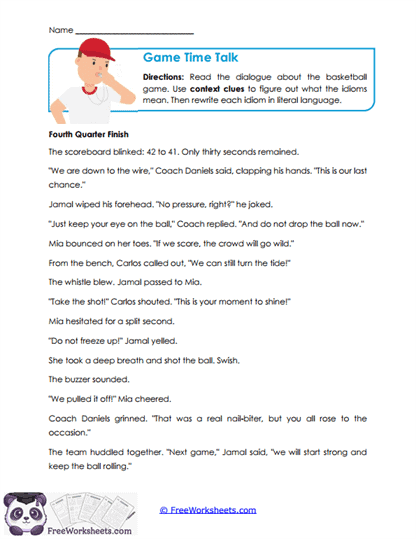
On this worksheet, students will read a dialogue about a basketball game. They identify idioms used in the conversation. Learners use context clues to determine their meanings. Students rewrite each idiom in literal language. Each task builds comprehension, interpretation, and application skills.
Common Challenges and Misconceptions
Students may interpret idioms literally instead of figuratively. Some may struggle to use context clues effectively. Others might provide incomplete or vague explanations. A common challenge is translating figurative expressions into clear literal meaning. Teachers should model how to use surrounding dialogue as clues.
Implementation Guidance
This worksheet works well for lessons on figurative language in real-world contexts. Teachers can model how to identify idioms and explain their meanings step by step. Parents can support by discussing common idioms used in daily conversation. Encouraging students to restate phrases in their own words strengthens understanding. This activity is especially effective for helping students connect classroom learning to everyday language use.
Details and Features
The worksheet includes a realistic dialogue passage. It provides structured tasks for identifying and rewriting idioms. The layout supports comprehension and application. It integrates reading and writing skills. It is printable and classroom-ready.