
About This Worksheet
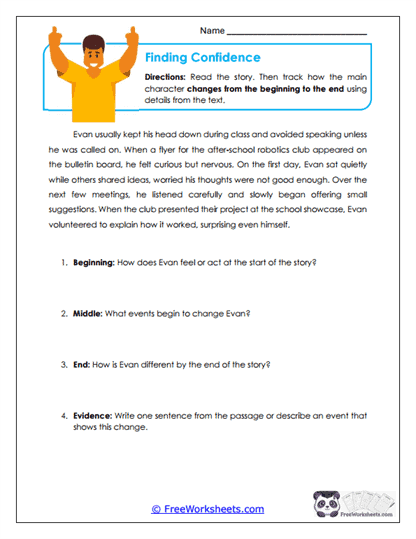
Character development analysis is a reading skill that requires students to track how a character changes throughout a story. This Grade 5 worksheet focuses on identifying beginning, middle, and end character traits within a narrative. Students examine actions and dialogue to determine how confidence develops over time. For example, avoiding speaking becomes volunteering to present, showing growth.
Curriculum and Grade Alignment
This worksheet is intended for Grade 5 students analyzing literary elements in fiction. Students should already understand basic character traits and plot structure. The next progression skill involves comparing character development across multiple texts. It aligns with Common Core Standard RL.5.3, which requires comparing and contrasting characters and their development. It also supports TEKS 5.7(B), focusing on describing character changes supported by textual evidence.
Student Tasks
On this worksheet, students will read a narrative about a student gaining confidence in a robotics club. They will describe how the character feels and behaves at the beginning, middle, and end of the story. Learners must cite a sentence or event that demonstrates the change. The responses require thoughtful analysis of character growth.
Common Challenges and Misconceptions
Students may describe events instead of explaining internal character change. Some learners might overlook subtle shifts in confidence during the middle of the story. Others may struggle to provide textual evidence that supports their claims. Teachers can encourage students to highlight specific actions that reveal growth.
Implementation Guidance
Teachers may use this worksheet during a literature unit focused on character traits and theme. It works effectively in small discussion groups before independent writing. Parents can ask guiding questions about how actions reveal feelings. The activity provides meaningful practice for narrative analysis skills.
Details and Features
The worksheet includes a short narrative passage and four comprehension questions. Questions guide students through identifying character change and supporting evidence. Adequate writing space allows for complete explanations. The clean format is suitable for classroom printing and distribution.